1. Въведение
This manual provides essential information for the setup, operation, maintenance, and troubleshooting of your Digilent Arty A7-35T Artix-7 FPGA Development Board. The Arty A7-35T is designed for makers and hobbyists, offering a versatile platform for digital design and embedded systems development using Xilinx Artix-7 Field-Programmable Gate Arrays (FPGAs).
2. Продуктът свършиview
The Arty A7-35T board integrates a Xilinx Artix-7 FPGA with various peripherals and expansion options, making it suitable for a wide range of projects. Key features include:
- Xilinx Artix-7 FPGA (XC7A35T-1CSG324C)
- Multiple Pmod connectors for peripheral expansion
- Arduino/chipKIT shield connector
- Ethernet порт
- USB-JTAG programming port
- User LEDs, switches, and buttons
- DDR3 SDRAM

Фигура 2.1: Отгоре надолу view of the Digilent Arty A7-35T Artix-7 FPGA Development Board. This image displays the overall layout of the board, including the central Artix-7 FPGA chip, various connectors, buttons, and LEDs.

Фигура 2.2: Детайлна горна част view of the Arty A7-35T FPGA board. This image highlights the placement of the Artix-7 FPGA, Pmod headers, Arduino shield connectors, Ethernet port, and user interface components like switches and buttons.
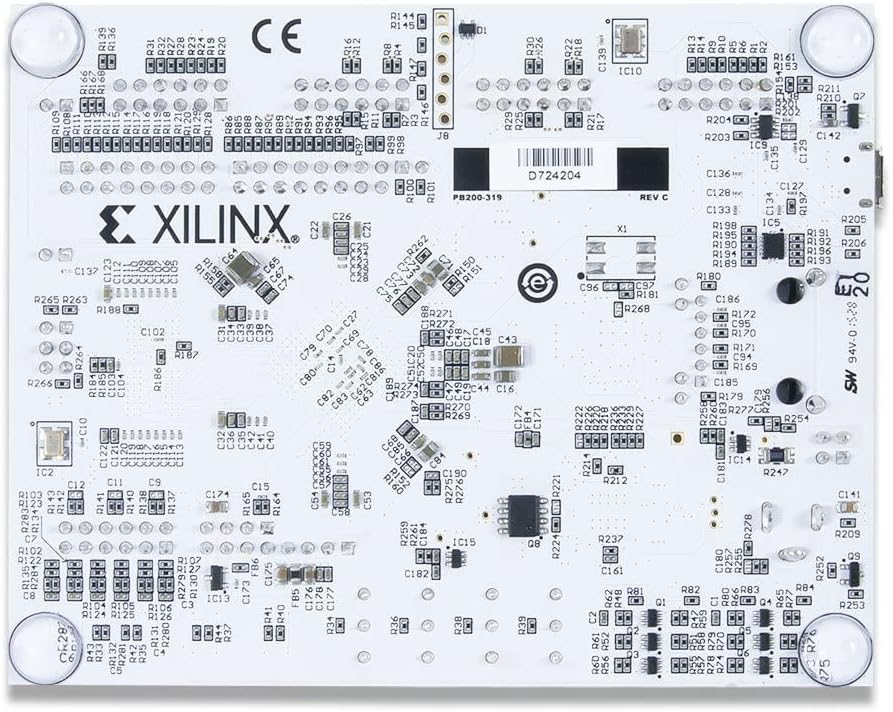
Фигура 2.3: Отдолу view of the Arty A7-35T FPGA board. This perspective shows the underside of the circuit board, revealing additional components and traces.
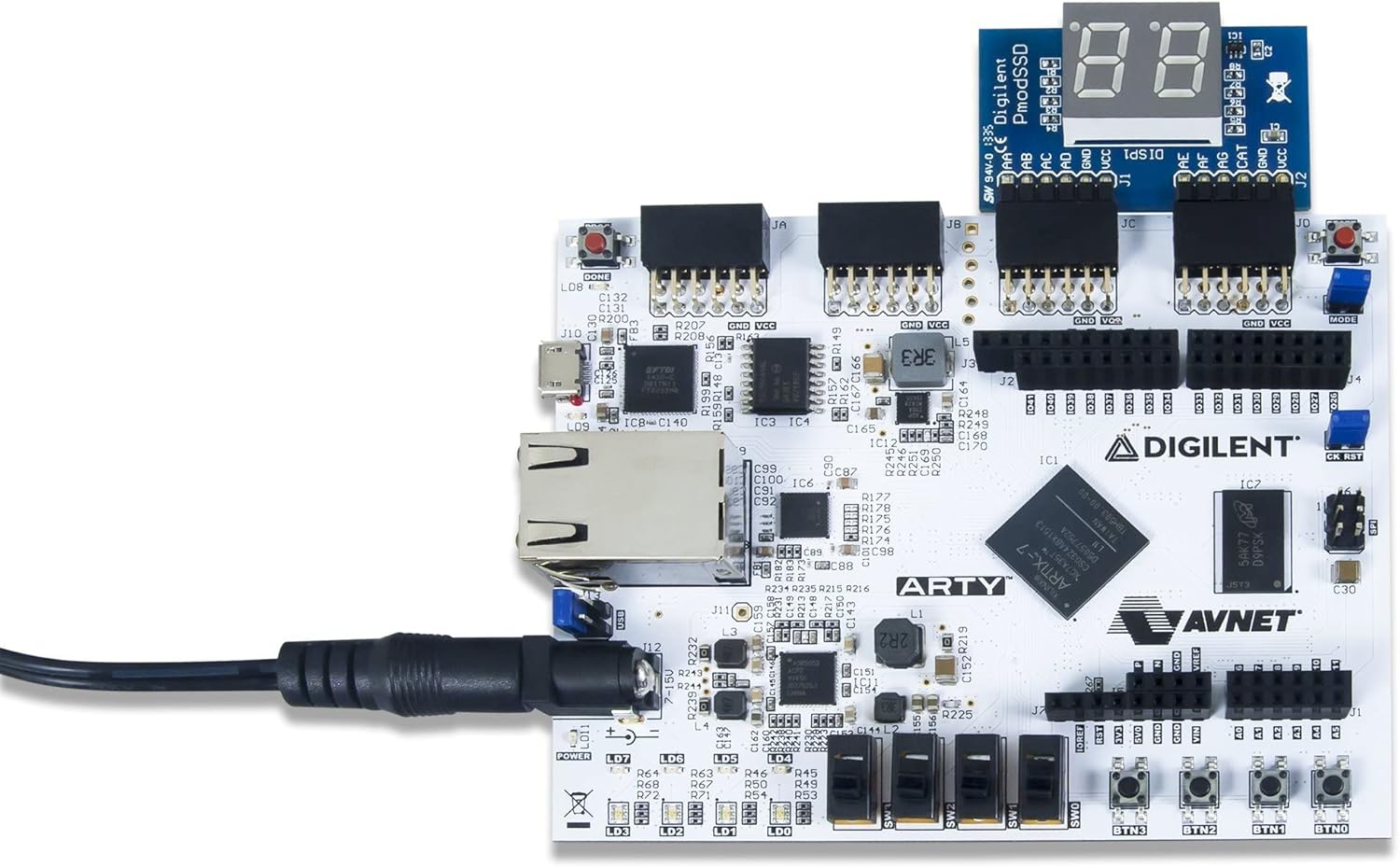
Фигура 2.4: Arty A7-35T board demonstrating connectivity with a Digilent Pmod accessory. This image illustrates how external modules can be interfaced with the board via the Pmod headers.

Фигура 2.5: The Arty A7-35T board in an operational state, indicated by illuminated power and user LEDs. This shows the board receiving power and potentially running a basic demonstration program.

Фигура 2.6: Страничен професионалистfile of the Arty A7-35T board, showcasing the various connectors such as the power input, USB port, and Ethernet port.

Фигура 2.7: A different side view of the Arty A7-35T board, providing a perspective on the board's height and the arrangement of its components from the side.
3. Настройка
3.1. Разопаковане и проверка
Carefully remove the Arty A7-35T board from its packaging. Inspect the board for any visible damage. Ensure all components are securely attached.
3.2. Захранване
The Arty A7-35T can be powered via the USB port or an external 7V-15V power supply connected to the barrel jack. For stable operation, especially when using power-hungry peripherals, an external power supply is recommended.
- Connect the USB cable to the micro-USB port (J10) on the board and to your computer.
- Alternatively, connect a compatible external power supply to the barrel jack (J12).
- Ensure the power select jumper (J11) is set to the appropriate source (USB or EXT).
3.3. Инсталиране на софтуер
To develop and program the Arty A7-35T, you will need the Xilinx Vivado Design Suite. Follow the instructions provided by Xilinx for installation. Digilent also provides board support files и example projects for Vivado.
- Download and install Xilinx Vivado Design Suite from the Xilinx webсайт.
- Install the Digilent board files for Arty A7, typically found on the Digilent website's resource center.
- Ensure USB drivers for the JTAG programmer are correctly installed.
4. Инструкции за работа
4.1. Включване
Once connected to a power source, the power LED (LD11) should illuminate, indicating the board is receiving power. If using USB power, your computer should detect the device.
4.2. Programming the FPGA
The FPGA can be programmed using the Xilinx Vivado Design Suite via the onboard USB-JTAG програмист.
- Open Xilinx Vivado and create or open an FPGA project targeting the Artix-7 XC7A35T-1CSG324C.
- Generate a bitstream (.bit file) for your design.
- Use the Hardware Manager in Vivado to connect to the Arty A7 board.
- Program the device with your generated bitstream.
The FPGA can also be configured from a Quad-SPI flash memory. Refer to Digilent documentation for details on programming the flash memory.
4.3. Using Onboard Peripherals
The Arty A7-35T includes several user-configurable peripherals:
- LEDs (LD0-LD3, LD4-LD7): Eight user LEDs for visual feedback.
- Switches (SW0-SW3): Four slide switches for digital input.
- Buttons (BTN0-BTN3): Four push buttons for momentary input.
- Reset Button (CK_RST): Resets the FPGA configuration.
These peripherals are connected to specific FPGA pins and can be controlled or read from your FPGA design.
4.4. Expansion Connectors
The board features Pmod connectors and an Arduino/chipKIT shield connector for expanding functionality with various modules. Ensure proper voltage levels and pin assignments when connecting external hardware.
5. Поддръжка
5.1. Общи грижи
Handle the Arty A7-35T board with care to prevent damage from electrostatic discharge (ESD). Always hold the board by its edges. Store the board in an anti-static bag when not in use.
5.2. Почистване
Ако е необходимо, внимателно почистете дъската с мека, суха четка или сгъстен въздух, за да отстраните праха. Избягвайте използването на течности или абразивни материали.
5.3. Актуализации на фърмуера
Periodically check the Digilent website for any firmware updates for the onboard USB-JTAG programmer or other components. Follow the provided instructions carefully for any update procedures.
6. Отстраняване на проблеми
6.1. Проблеми със захранването
- No Power LED (LD11): Check power source connection (USB or external adapter) and ensure the power select jumper (J11) is correctly set. Verify the external power supply provides 7V-15V.
6.2. USB Connectivity Problems
- Board not detected by computer: Ensure USB cable is securely connected. Try a different USB port or cable. Verify that the necessary USB drivers for the Digilent JTAG programmer are installed on your computer.
6.3. FPGA Programming Errors
- Vivado Hardware Manager cannot find device: Confirm USB connection and driver installation. Ensure the board is powered on. Check that the correct device (Artix-7 XC7A35T) is selected in your Vivado project.
- Programming fails: Verify your bitstream is correctly generated and compatible with the Artix-7 FPGA. Ensure no other software is interfering with the JTAG връзка.
6.4. Unexpected Behavior
- Design not functioning as expected: Review your HDL code and constraints. Use Vivado's debugging tools (e.g., ILA, VIO) to inspect internal signals.
- Board becomes unresponsive: Press the CK_RST button to reset the FPGA configuration. If issues persist, power cycle the board.
7. Спецификации
| Характеристика | Стойност |
|---|---|
| Марка | Digilent |
| Име на модела | 410-319-1 |
| FPGA | Xilinx Artix-7 (XC7A35T-1CSG324C) |
| RAM | LPDDR |
| Скорост на паметта | 667 MHz |
| Размер на инсталираната RAM памет | 256 MB |
| Капацитет за съхранение на паметта | 256 MB |
| Технология за свързване | Ethernet |
| Съвместимост на операционната система | Linux (and Windows/macOS with Vivado) |
| Тегло на артикула | 0.705 унции |
| Размери на продукта (ДxШxВ) | 4 x 3 x 1 инча |
| производител | Digilent |
| Дата на първа наличност | 29 октомври 2015 г |
7.1. Какво има в кутията
- Digilent Arty A7-35T Artix-7 FPGA Development Board
- Access to 2 free eBooks: IDD VHDL Edition and Real Digital book
8. Гаранционна информация
For detailed warranty information regarding your Digilent Arty A7-35T Artix-7 FPGA Development Board, please refer to the official Digilent website or contact Digilent customer support directly. Warranty terms and conditions may vary by region and purchase location.
9. Поддръжка
For further assistance, technical documentation, tutorials, and community forums, please visit the official Digilent webсайт:
- Digilent Webсайт: https://digilent.com/
- Product Resource Center: Look for the Arty A7-35T on the Digilent website for specific documentation, schematics, and example проекти.
- Форуми на общността: Engage with other users and Digilent engineers for support and project ideas.
Можете също да посетите Digilent Store on Amazon for product information and related items.


